↓
 
Xanthos heroons

Tolun's private Turkey tours

Experienced archaeologist tour guide offering custom tours in Turkey.

  • Home
  • My Resumé
  • Testimonials
  • Accommodations
  • Transportation
  • Suggested Tours
  • Prices
  • Contact me
  • Blog

Post navigation

← Older posts
Newer posts →

Mysterious Acropolis of Pergamon

Tolun's private Turkey tours Posted on September 8, 2021 by MarielleSeptember 8, 2021
Pergamon acropolis

We were driving up the hill to Acropolis of Pergamon and passed the small homestead. There chickens were pecking around the ancient pieces of fortification wall and antique stone ruins were scattered among wooden sheds and huts in the backyard of the farmhouse. This kind of nonchalant attitude to antiquities is only possible in places spoilt for architectural wonders of the past.

As we ascended the hill, we saw the water reservoir down below. I was surprised how much the water level had decreased compared to how I remembered it from my last visit to Pergamon acropolis a few years ago. Everyone is talking about water shortages and hotter and drier weather than normal these days.

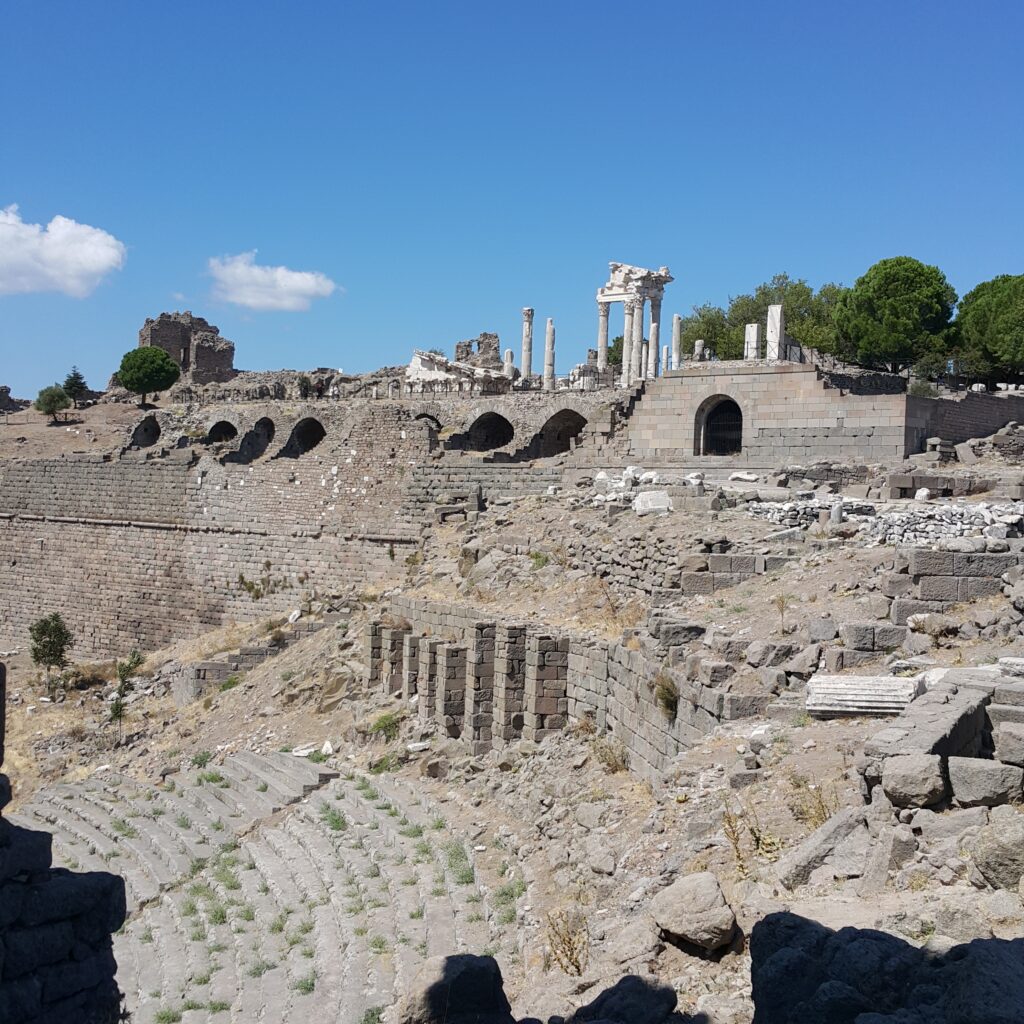
After reaching the summit we were rewarded by strong cool breeze blowing steadily and as a result the heat of the early September sun rays were easier to bear. The weather was clear and from the top of the steep amphitheatre I could see the sea glistening in the sun on the horizon. We were standing nearly 30 km away from the sea at this point.
pergamon acropolis
Pergamon Acropolis

Climbing up and down this theatre is not for the faint-hearted. I am not afraid of heights but even I felt my heart trembling a bit when gingerly taking the steps between the rows of seats sloping sharply downward. Looking down, we saw the sea of read rooftops of the city at the foot of the acropolis. We recognized the Maltepe tumulus among the buildings where we had been just before visiting acropolis. Tumulus is a man made hill where kings and other dignitaries were buried inside the stone built burial chamber during Hellenistic times. Seven such tumuluses have been found in Pergamon area.

This time I will not delve into describing the gleaming white marble columns and remains of different temples and other monuments at the site as I already did that in my earlier post about Pergamon a few years ago https://privatetourturkey.com/en/spectacular-pergamon/. This time I just enjoyed the atmosphere and let my senses absorb the surroundings.

Pergamon was a rich and important city, especially before the rise of Constantinople. It was founded in the 3rd century BC to be the capital of the Attalid dynasty. As Tolun says, Philetairos got 9000 golden talents from Lysimachus, the general of Alexander the Great, and used at least some of the money to reinforce and develop the city.

pergamon temples
Marble columns of temples Pergamon

Tolun writes:”One golden talent must have been the equivalent of 33 kg of gold in those times the sum would correspond roughly to 9000 X 33 kg =297000 of kg of gold. The burial chamber of the possible tomb of Lysimachusat Belevi was blown up by treasure hunters and there seems not to be one single coin of gold. So would it be hidden in the Acropolis of Pergamon? Since the money was given to Philetairos and he spent some of it for the fortification of the walls of the city and kept the remaining part himself, one must think he was very rich and the money might have been inherited by succeeding rulers? Philetairos founded the Pergamon kingdom in 281 BC. and the kingdom lasted until 133 BC when it was handed over to the Romans with the testament of the last king of Pergamon, Attalus the III. During this period Pergamon kingdom didn’t appear to lose a battle. The battle against Galatians at Caecus river (Bakircay down below the town) at 241 BC and the one fought at Magnesia against Anthiochus III of Seleucid dynasty in 190 were victorious. So could it be that all that money was spent for the construction of the fabulous Acropolis? Acropolis was nicely built and was full of beautiful monuments including the Altar of Zeus, which was one of the seven wonders of the world in the Hellenistic period. However they could be built only with a small fraction of that huge sum. It would be logical to think that Philetairos and his successors must have had large sums of gold but were they so naive to hand over money to their Roman allies? I would still think that all the money was not spent and parts of it must be stored somewhere at some very safe place.”

Pergamon was known as cultural and political centre, even the capital of Roman province of Asia in Roman Empire. Nearby there was also a famous healing and medical centre called Asclepion. Pergamon had a well-known sculpture school as well as one of the biggest libraries in the world at its time.

I had been here a few times and Tolun maybe about 100 times but neither of us had seen before the small crosses carved into pavement slabs by Trajan Temple. What were they for? Tolun had seen such crosses in Hagia Sophia in Istanbul which were used as measuring points. But here, in Pergamon Acropolis, could the reason be the same? They didn’t seem to be carved in orderly fashion, looked more randomly scattered. But not all is what it seems… It remains a mystery to us. Just as the Acropolis of Pergamon itself remains a mystery with many legends and stories what might have happened here in the days when instead of a museum, this place was full of people going on about their everyday business and living their lives in the beautiful streets and magnificent buildings.

pergamon amphitheatre
Pergamon amphitheatre
Posted in Uncategorized | Tagged Acropolis, archaeology, Greek, Pergamon, Roman, Turkey | Leave a reply

The tale of Iznik

Tolun's private Turkey tours Posted on April 22, 2021 by MarielleMay 1, 2021

While driving southwards from Istanbul we stopped by the magnificent Iznik lake with mesmerisingly beautiful blue water. It is not surprising that a long time ago people decided to settle in this gorgeous place and build a city here. The earliest tale of Iznik is a bit unclear. Lysimachus took the the town from Antigonus after winning the Battle of Ipsus in 301 BC. Then he named this Bithynian town after his wife Nicaea.

In Roman times Nicaea was an important city. In the middle of the town people could see all four gates to the city as the main streets form a cross with end points at the gates and middle point at the city centre. This was a typical Hellenistic way of city planning.

iznik palace
Remains of the Senate’s Court where First Ecumenical Council is thought to be held
First Ecumenical Council

In the 4th century the Emperor Constantine the Great assembled the first Ecumenical Council in Nicaea. He and other leaders of Christianity wanted to bring consensus to the church in the first time of Christianity’s history. Here they wrote the Nicene Creed, a unified declaration and summary of Christian doctrine. We saw the ruins of the Senat’s Court where the council is thought to be gathered at the shore of the lake.

After suffering two earthquakes and the competition from rising power of Constantinople, Nicaea started to lose its significance. Its thick walls, however, and the gates, have largely remained intact to this day. We found the Lefke gate to be especially impressive, with the aqueduct attached to it. In the 2nd century AD the Roman Emperor Hadrian commissioned the aqueduct to be constructed and it has been operational until the 20th century! The walls of the city are very well preserved and they are built in similar manner to Constantinople walls with red bricks and stone.

Recently, in 2014, a sunken basilica near the shore of the lake was discovered. This is a remarkable contribution to the history of Iznik. The church is believed to be built in the late 4th century, but probably the earthquake in 740 AD destroyed it and it sank into the lake. There are plans to create an underwater museum there.

Lefke gate
Lefke Gate and aqueduct in Iznik
Seventh Ecumenical Council

Few centuries went by and Nicaea saw an earthquake and attacks by Muslims among other events. Yet again its importance increased in the 8th century when the Seventh Ecumenical Council gathered here, also called Second Council of Nicaea. Prominent members of the Christian religion convened at the Hagia Sophia church with the aim to condemn the Byzantine iconoclasm. Emperor Constantine V banned veneration of icons and the council intended to get the ban abolished. The pope eventually formally approved the council’s decree to restore veneration of icons.

Nicaea became an important administrative and trading centre again. In the 10th and 11th centuries it became a base for rebellions against Constantinople, fell briefly under Seljuk Turks’ rule, but returned to Byzantine rule again in less than 20 years later.

Crusaders conquered Constantinople in 1204, but Nicaea managed to remain autonomous. Four years later Theodore Laskaris founded Empire of Nicaea where also exiled Patriarchate of Constantinople resided. For half a century Nicaea enjoyed the prominent position, until Byzantines recaptured Constantinople. After that the city began to decline again.

yenisehir gate
Yenisehir Gate, Iznik
Ottoman rule and Iznik tiles
Iznik clock tower
Iznik Clock Tower

Ottomans conquered Nicaea in 1331. They changed the name of the town to Iznik and for a while it became their capital. This was a notable milestone in the history of Iznik. Ottomans converted Hagia Sophia church into a mosque and started to construct other Islamic buildings. After the Ottoman conquest of Constantinople in 1453, however, Iznik lost its capital status.

hagia sophia iznik
Hagia Sophia, Iznik

In the 16th and 17th century Iznik became to be known for its pottery and tile making. The first time I heard of Iznik tiles was years ago when I visited famous Sultan Ahmed Mosque aka Blue Mosque in Istanbul. Perhaps this is the most known landmark where Iznik tiles decorate the building . Indeed, it is called Blue Mosque because of the striking effect the beautiful mainly blue and white intricately patterned tiles have on the walls of the mosque. However, before Blue Mosque was built, Iznik tiles were used in decoration of many other mosques and imperial buildings in Istanbul, Bursa and other towns. Famous architect Mimar Sinan designed many of those buildings . One such well-known construction is Suleymaniye Mosque in Istanbul, built in 1555.

fountain by iznik lake
Fountain by Iznik Lake

Iznik tiles were painted mainly in dark blue, turquoise, coral red and emerald green colours on the white base and underglazed. The complicated process produced unique tiles which are up to 80 per cent composed of quartz and quartzite. Nowadays there are works underway to revive the old techniques of Iznik tile and pottery making. There are art centres and souvenir shops in the town selling beautiful Iznik pottery.

Before we departed this wonderful town we stopped again by the lake for a short walk by the beach. The setting was just breathtakingly beautiful! The green grass next to brilliant blue waters…very soothing. Although these days Iznik is a small town in terms of population, its cultural and historical heritage makes it a great city worthy of visit by any art and history lover.

Posted in Uncategorized | Leave a reply

Post navigation

← Older posts
Newer posts →
instagram
linkedin
↑