↓
 
Xanthos heroons

Tolun's private Turkey tours

Experienced archaeologist tour guide offering custom tours in Turkey.

  • Home
  • My Resumé
  • Testimonials
  • Accommodations
  • Transportation
  • Suggested Tours
  • Prices
  • Contact me
  • Blog

Post navigation

← Older posts
Newer posts →

Cozy Beylerbeyi Palace

Tolun's private Turkey tours Posted on September 17, 2022 by MarielleSeptember 18, 2022

Many people who come to Turkey, start exploring this country from Istanbul. This huge and exciting metropolis has a lot to offer and there a are plenty of beautiful places for sightseeing. Beylerbeyi Palace, while not the most well known, is one of many Ottoman palaces on the shores of Bosphorus. A couple of days ago we decided to go and pay this palace a visit.. It is situated in the Asian side of Istanbul, in Üsküdar district. One can take a sea bus from the European side across Bosphorus to Üsküdar and from there a bus ride for another 15 minutes and there you are.
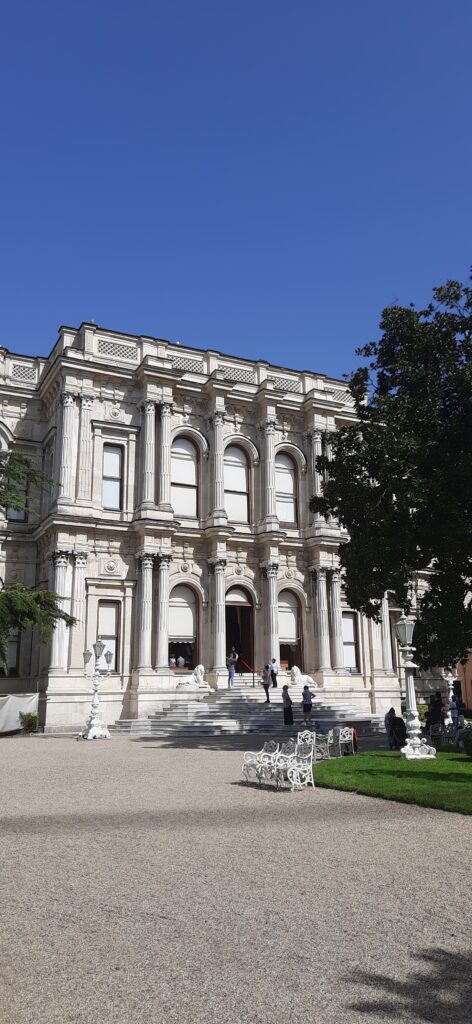
beylerbeyi palace
Beylerbeyi Palace in Istanbul

Beylerbeyi has been a residential area since Byzantine times. The first Ottoman palace was built here by the orders of Sultan Mahmud II (1808 – 1839). It was a wooden construction and after it burned down, Sultan Abdulaziz had a new palace built in 1863. The palace was built within two years, there are 24 rooms and 6 halls on three levels. We entered the beautiful gardens with ponds, then walked along the Bosphorus promenade and came to the grand entrance of the palace. The days are still quite hot and a nice breeze from the seaside was very pleasant as the palace sits only a few meters from the shore. We walked up the steps and came to the entrance hall. Big baccarat crystal chandeliers were in every room we saw – beautiful transparent cut crystal with some moss green and blood red pieces. Thick patterned carpets from Turkish town of Hereke, and Egyptian woven reed matting were covering parquet floors. Landscape paintings on the walls, sumptuous soft furnishings everywhere. The rooms were well proportioned and colourful. All this gave otherwise a large palace a somewhat cozy feeling. The reception rooms and halls gave a luxurious impression. Large beautiful painted vases from China, Japan, France, Germany and Turkey were decorating halls. There were big clocks from England, France and Turkey. One of the grand halls had a large marble pool with a fountain in the middle. All the rooms we saw had tall windows and were filled with light, many with great views over Bosphorus. High ceilings were painted with nautical scenes and intricate geometric patterns. The palace gave a nod to both Orient and Occident.

The sultan, his wife and his mother had their own bedrooms. Sultan’s mother also had her own reception rooms. There were bathrooms with shower and a bath, and there was a hamam as well. Again, I couldn’t help but feel that even if the sultan was home ‘alone’, it wouldn’t feel a lonely, cold place, but instead the palace had a cozy, homely vibe, even though it was large and luxurious. Maybe it was the combination of good architecture and the fully carpeted floors and also the bright, cheerful colours and comfortable furnishings… And of course the light, the magnificent light streaming in through the windows, bouncing off the crystals of the chandeliers and dancing around the walls of the palace… It was all really gorgeous.

This beauty was shared with many foreign dignitaries of its time. The guests who stayed here included Eugenie, Empress of France, Franz Joseph, Emperor of Austria-Hungary, German Emperor Wilhelm II, Nikola, King of Montenegro, Duke and Duchess of Windsor among others. The palace was used as a summer residence and a State Guest House. One of the last sultans of Ottoman Empire, Abdulhamid II, spent the final six years of his life in Beylerbeyi Palace after he was dethroned, and he died here in 1918.

The gardens of the palace are also spectacular. There are lots of rose bushes lining the garden paths, pools and terraces, three kiosks. There is an abundance of shady mature trees such as magnolia and chestnut, linden and judas trees, planted in the period of Abdulhamid II.

So if you have already seen the main tourist attractions at the Golden Horn, why not pay a visit to the magnificent, yet cozy Beylerbeyi Palace. You’ll enjoy it!

Posted in Uncategorized | Tagged Istanbul, travel, Turkey | Leave a reply

Atarneus and Aristotle

Tolun's private Turkey tours Posted on February 7, 2022 by MarielleFebruary 7, 2022
Atarneus

Atarneus is one of the ancient Greek cities which unlike many others, is not known for political, commercial or architectural reasons. Its significance lies in its people, of whom most notable was Aristotle. Aristotle’s influence on science and philosophical studies through ages up to today’s modern world is impossible to overestimate. His teachings have contributed greatly to almost every subject of knowledge in the West.

Finding Atarneus

Atarneus had remained elusive to us until a few days ago. We had been looking for it earlier but couldn’t find it. This time we were lucky. Although there were no sign posts and google maps only gave an approximate location, we persisted and were rewarded. We arrived at the end of the dirt track by a farm house. Nothing there suggested that we were looking straight at the historical site. Just hills with goat and sheep trails and creeks running down the slopes after days of heavy rains and thunderstorms. We decided to start walking up the nearest hillside anyway. If we couldn’t find a city, at least we would have a nice walk in the nature.

Atarneus ahead
Atarneus ahead

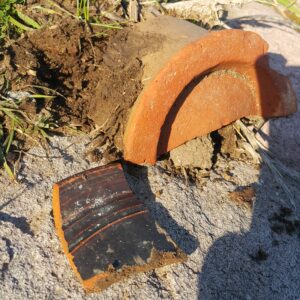
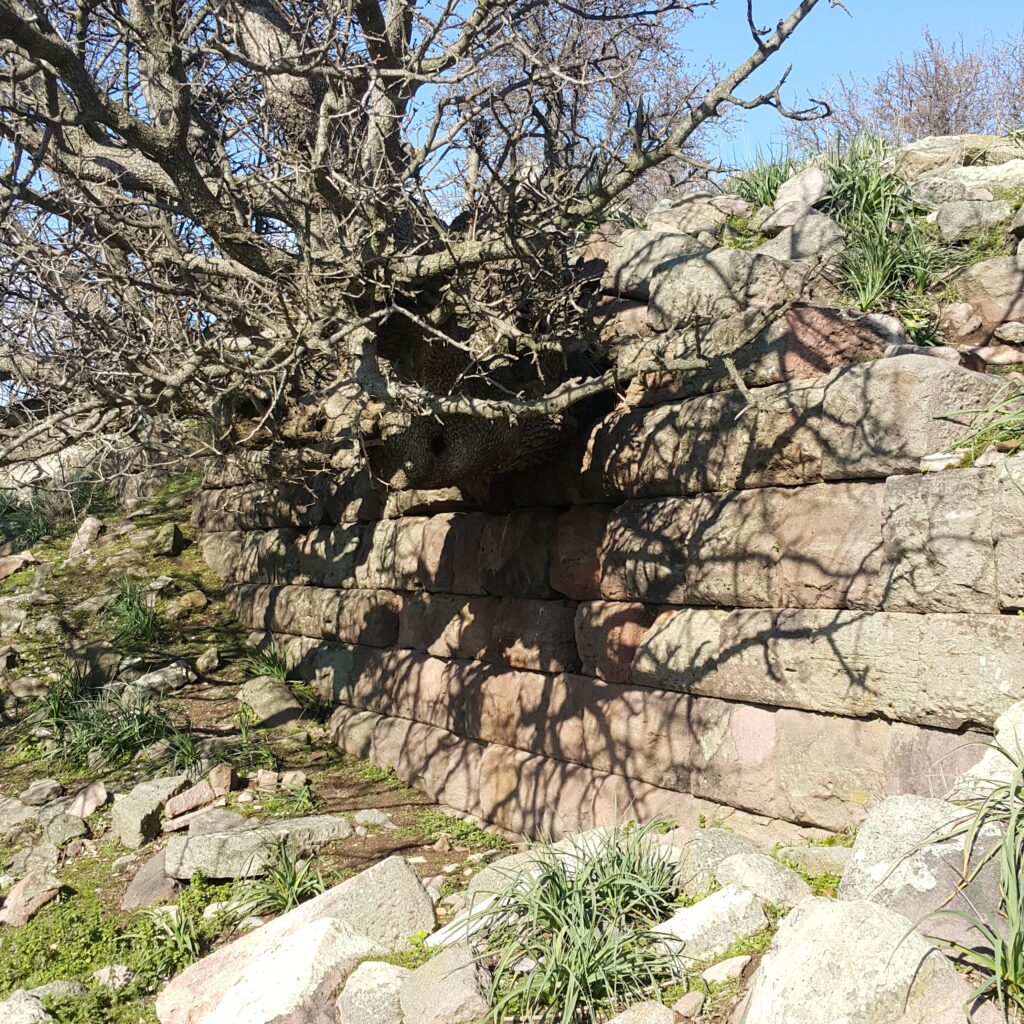
However, while climbing, we were trying to look for some signs of civilisation amongst the trees and rocks. And there, up the hill, We spotted a structure like a wall of some sort. We decided to go and investigate. The hill was really quite steep to climb, lots of loose rocks on the way. But I noticed something else. Indeed, the signs of human activity started to appear, more and more different shapes of pieces of ancient pottery scattered allover the hillside. And we were right – there really was an ancient stone wall halfway up the hill. It looked like a thick outer wall of a city. Encouraged by this find, we continued climbing upwards. At the top of the hill we could see more pieces of walls, steps, shapes of buildings, but mostly piles of square-cut stones. It looked like this place had not been visited by many people in modern times. Atarneus seemed like a site holding a lot of secrets still undiscovered underneath the earth and stone rubble.

Ancient Atarneus

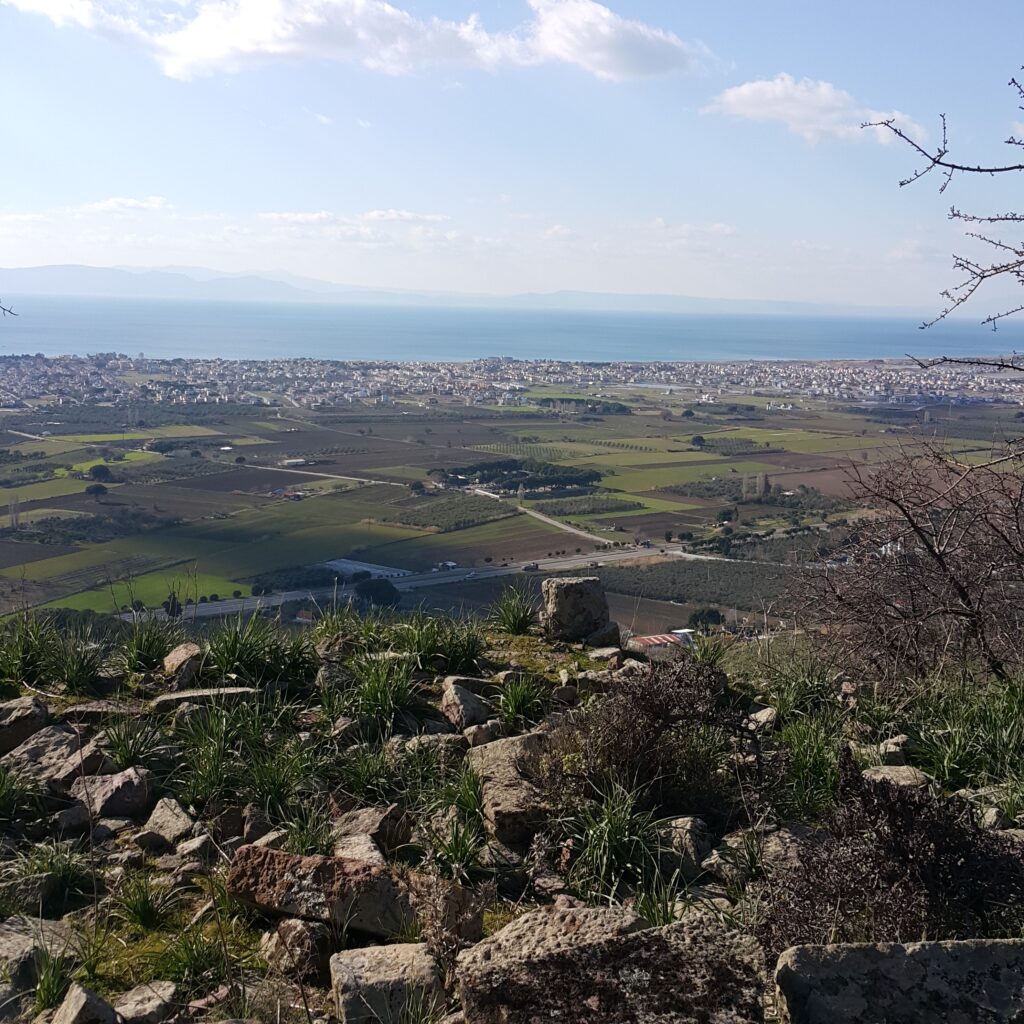
The people who lived there long time ago enjoyed a 360 degree views far into the distance, excellent position to spot the possible invaders. The Aegean sea at the West, with the seaside town of Dikili visible on the shore. Lesbos island can be seen across the sea. The other sides of the hill were surrounded by low fertile plains and mountains in the distance. In ancient times this region was called Aeolis of Asia Minor. According to Herodotus Atarneus was given To Chians by Cyrus the Great in exchange for the Lydian king Pactyes.

Atarneus ruins
Ruins of Atarneus

Atarneus flourished in the 4th century BCE when it was ruled by Hermias who was a friend of Aristotle. After his father died, Aristotle was taken care of and educated by Proxenus of Atarneus, who may have been his uncle. Proxenus married Aristotle’s older sister Arimneste and they had a daughter Hero and a son Nicanor. Nicanor later married Aristotle’s daughter Pythias. Heros’s son Callisthenes became a student of his great-uncle Aristotle. Callisthenes became a well-known Greek historian who accompanied Alexander the Great during his Asiatic expedition.

Atarneus pottery
Some pieces of pottery we found in Atarneus

Aristotle and Hermias

Aristotle studied at the famous Plato’s Academy in Athens for nearly twenty years and it is there where he became friends with Hermias who was sent to study there for several years when he was young. Hermias was a slave to Eubulus, a Bithynian banker who got Atarneus as a guarantee for lending money to a Persian official. After Hermias won his freedom, he became the ruler of Atarneus and Assos.

Atarneus wall
Ancient wall of Atarneus

Plato’s philosophy has been instrumental in Western thought and Aristotle’s philosophy even more so. After Plato’s death Aristotle together with Xenocrates travelled to Atarneus. Aristotle stayed with Hermias in Atarneus for two years. During his stay there, Hermias became quite influenced by Aristotle and his ruling methods became less tyrannical and more according to Aristotle’s teachings. Aristotle married Hermias’s niece or daughter Pythia. After Hermias died, Aristotle travelled to Lesbos together with his pupil Theophrastus to study botany and zoology of the island. He dedicated a statue in Delphi and wrote a hymn in honour of Hermias who was betrayed, captured and tortured to death by Persian king’s order as Hermias remained loyal to Macedonian king Philip II and wouldn’t divulge his secrets. Later Aristotle went on to be a teacher of Philip’s son Alexander the Great.

Fate of Atarneus

By the 1st century BCE Atarneus was deserted probably as a result of the rioting against Romans. It is found that most towns around Pergamon area were deserted at the 1st century BC. It is thought they were involved in the riots against Romans and their inhabitants fled their homes from Romans’ punishments. It is likely that at that time the people of Atarneus also left their homes and later went to live in Pergamon as it was the most powerful city in the area.

What I really liked about Atarneus was its beautiful and peaceful setting. This is not a site that many people visit. Time has stood still there for over two thousand years. It is not hard to imagine Aristotle and his contemporaries sitting at the terrace of a villa there, admiring the sun setting behind the mountains of Lesbos island, contemplating about life…

Views of Aegean sea from Atarneus
View from Atarneus towards the Aegean sea and Lesbos island
Posted in Uncategorized | Tagged Aegean, Ancient Greece, Aristotle, Atarneus, Hermias, Turkey | Leave a reply

Post navigation

← Older posts
Newer posts →
instagram
linkedin
↑